AI Is No Longer Optional - No AI, No Edge. (The Cestrian Circle Newsletter).

DISCLAIMER: This note is intended for US recipients only and, in particular, is not directed at, nor intended to be relied upon by any UK recipients. Any information or analysis in this note is not an offer to sell or the solicitation of an offer to buy any securities. Nothing in this note is intended to be investment advice and nor should it be relied upon to make investment decisions. Read our full disclaimer, here.
The Future Is Now
by Alex King, CEO, Cestrian Capital Research.
I’m proud that here at Cestrian we use AI all day every day to improve our investing and trading analysis, and have done so for some years now. The latest LLM tools, be they simple chatbots or fully fledged agents, have transformed our business, in every function from underlying research to administrative tasks to marketing. Just a couple years back we would need 5-10x the human resource to deliver the work we currently do. And I think we are way early in this. Remarkable.
The most tangible outputs from our use of machine learning is our families of algorithmic signal services. We offer two types of algorithmic signals:
- SignalFlow AI services are based on purely quantitative statistical models
- YX Insights services are based on multifactor macro models
Today I’m going to walk you through the SignalFlow AI family. Look for a note in a few days covering the YX Insights family.
How To Use SignalFlow AI In Your Trading And Investing
SignalFlow AI is a proprietary two-model quantitative system developed by Prof. Jay Urbain, Ph.D.
Like all the best quants, Jay comes to finance from a focus elsewhere. This, I believe, is key to the innovative methods within the SignalFlow AI models. If you hire people from the dominant funds, you’ll get the standard thinking. If you bring people in from other industries, you get a new take on problems. Jay’s experience spans commercial and academic work in radar countermeasures, 3D robotic guidance and calibration, machine learning and natural language processing models for intelligence applications, and extensive medical image synthesis and analysis work. Like all very smart and accomplished folks, this is all served up with a healthy dose of humility.
All SignalFlow AI services use a risk model and a ranking model in order to choose positions from a list of ETFs. The risk model forms a view on whether the ETF in question is in a “risk on” (good) or a “risk off” (bad) state. The ranking model decides which of the ETFs within each service are most and least compelling. Every SignalFlow AI service has a very simple output; at the close each day they print a short list of tickers - usually two or three - that the models believe can perform well during the next trading day.
The output looks like this (an extract from the SignalFlow AI Sector Rotation service):

So at today’s close, the Sector Rotation models held the view that owning energy, biotech, and cash (ICSH is a very short term bond fund akin to cash - some users just use cash!), is a promising setup for tomorrow. Of course, the algos won’t make every call correctly; many times their opinions will be wrong. But risk management is built into the models; they will get out of a losing position fast, much faster in my experience than even a skilled human trader.
Subscribers to the SignalFlow services can either follow the trade opinions mechanically (this is what I do myself with my own capital by the way), or just use the signals as a helpful input to their own analysis. If, for instance, you were thinking of buying $XLE and the model said it was a good idea, it might confirm work you had already undertaken and give you some confidence. Equally if you were about to buy $XLK and the model thought it was a bad idea, you might think twice or at least pause for more thought.
If trading mechanically you may choose to do something like I do. For each SignalFlow service I trade - of which more below - I allocate a starting pool of capital. I use all that capital to buy the first 3 ETFs published in the specific service I am using. Let’s say those ETFs are $XLK, $GLD, $XAR. The signal comes along just after the close, I may buy those ETFs at the following open, or in post-market hours as the signal is printed. Tomorrow there will be another set of signals. If no change in the signals, I do nothing. If the signals are $XLK, $GLD, $SMH, then I would sell all $XAR and take that exact dollar amount and use it to buy $SMH. This is how the models assume you trade when they calculate performance.
SignalFlow AI Model Performance
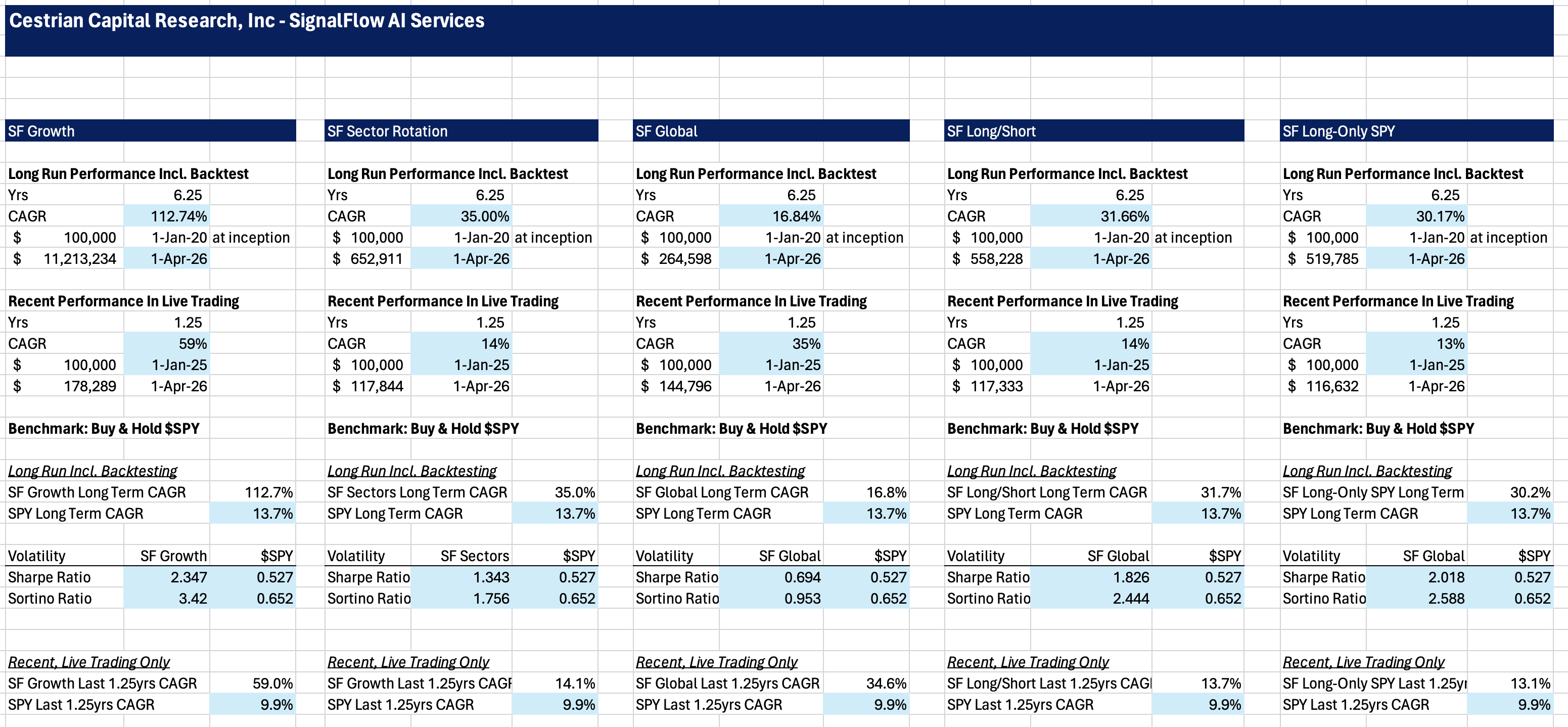
We offer a series of SignalFlow AI services to suit multiple types of portfolio approach. Here’s a snapshot of how they have performed to date. Note, the 6.25yr period includes about 5 years of backtesting; that’s interesting, but of course backtesting is backtesting. The most relevant performance data I think is the period from 1 Jan 2025 to date - this is all live trading.
Note that all these model performance numbers are for simple, unlevered setups, and the services use liquid ETFs only, no options, no futures, no leverage, nothing complicated whatsoever. Which only adds to the appeal in my view!
SignalFlow AI Growth is the top performer so far. It is designed to maximize returns in bull markets, whilst keeping drawdowns to a minimum. It rotates through a selection of high beta ETFs and defaults to cash if the market moves risk-off. $100k committed to this strategy on 1 Jan 2025 would deliver $178k today, a 59% CAGR over the period vs. 10% for SPY over the same period. Volatility has been surprisingly low; over a 6.25yr period including backtesting, this algo has had a Sharpe ratio of 2.3 and Sortino of 3.4, vs 0.53 and 0.65 respectively for the $SPY. You can learn more about this service here.
SignalFlow AI Global has also delivered. This service rotates through country ETFs and is intended to take advantage of global markets when they are outperforming the S&P500. If the S&P is stronger, the model selects $SPY, and if the global equity market is risk-off, the model selects cash. Including some backtesting and some live trading, the model has delivered value of $145k today for every $100k committed on 1 Jan 2025, a CAGR of 35% vs. 10% for SPY in the same period. You can learn more here.
SignalFlow AI Long/Short is a favorite of mine. It is intended to do what it says on the tin. Be long when the market is bullish, cash when sideways, short when bearish. This service is extremely simple to use - the positions are long $SPY, cash, or short $SPY (you can use long $SH instead if you prefer, $SH being a 1x inverse SPY ETF as you know). This has delivered a CAGR of 13.7% since 1 Jan 2025 vs. 10% for buy & hold $SPY; it has also achieved a very high Sharpe and Sortio ratio in the last 6.25yrs, including backtesting, at 1.8 and 2.4 respectively. This algo is highly suited to use in levered environments as a result. Read more about the service here.
Finally for now, SignalFlow Sector Rotation is a wonderful way to try to beat buy and hold $SPY by owning only the best-performing S&P500 sectors at any one time. Over the last 6.25yrs, including backtesting, it has more than doubled buy & hold $SPY returns; since 1 Jan 2025 in live trading, it has clocked up 14.1% CAGR vs. 10% for buy and hold $SPY. If you want to run your own money conservatively but still hope to outperform, this may suit you very well. This service is perfectly suited to investment managers or investment advisers with a cautious client base; the service is intended to be market-neutral (the S&P can be falling but some of its sectors be rising) and to default to cash if the market at large is risk-off. Learn more here.
Multiservice Rates Available
Please note many of our subscribers use multiple SignalFlow AI services, as do I. If you are interested in a multiservice subscription, don’t sign up at the rack rates, instead contact us at minerva@cestriancapital.com and we will give you a multiservice discounted rate based on which services you want to take.
Don’t sleep on AI. Because it sure isn’t sleeping.
Cestrian Capital Research, Inc - 1 April 2026
Appendix - SignalFlow AI Performance Tracker - All Services