
Akamai ( AKAM ): Does the AI Inference Wave Rescue the Original Edge Company?

DISCLAIMER: This note is intended for US recipients only and, in particular, is not directed at, nor intended to be relied upon by any UK recipients. Any information or analysis in this note is not an offer to sell or the solicitation of an offer to buy any securities. Nothing in this note is intended to be investment advice and nor should it be relied upon to make investment decisions. Read our full disclaimer, here.
by Alex King, CEO, Cestrian Capital Research, Inc and Claude CoWork.
Introduction
Akamai ( $AKAM ) has seen its stock on a real run up of late. I wanted to dig into whether the rally could have legs based on fundamentals or positioning, or whether the stock was just up with the market. The note below was drafted by Claude CoWork in response to extensive prompting; I’ve edited it somewhat thereafter.
Akamai is the original edge company. It invented the content delivery network (CDN) in 1998, it owns one of the most distributed networks on the planet, and it spent the better part of a decade watching Cloudflare ($NET) build a far more valuable business on essentially the same physical idea. The AI inference wave now hands Akamai a second chance to monetize that distributed footprint — this time as a place to run models close to users rather than a place to cache video.
The question for the stock is not whether AI helps Akamai — at the margin it clearly does, and the early data is real. The question is whether AI helps enough, fast enough, to outrun a structurally declining legacy delivery business and re-rate a stock the market has filed under "value trap”. Our read: the setup is more interesting than it has been in years, but the thesis rests on execution in a capital-intensive business where Akamai is the challenger, not the incumbent, despite its longer time in existence.
The early mover who got lapped
The context that frames this whole discussion is the divergence with Cloudflare. Both companies sell roughly the same basic service — a globally distributed network that sits between end users and origin infrastructure. Akamai got there more than a decade earlier and at far greater scale. Yet as of mid-2026 Cloudflare carries a market capitalization around $88bn against Akamai's roughly $23bn, despite Akamai generating more than six times Cloudflare's revenue.
The reason is growth and narrative, not technology per se. Cloudflare treated the edge as a programmable platform from day one — a single control plane spanning CDN, WAF, DDoS, DNS, zero-trust and, latterly, a developer compute layer (Workers) that primed it perfectly for the AI moment. Akamai treated the edge as infrastructure: plumbing, sold enterprise-by-enterprise, with a delivery business that has now declined for seventeen consecutive quarters. The market pays ~40x sales for Cloudflare's 30%+ growth and a few turns of revenue for Akamai's mid-single-digit growth. The upside opportunity in AKAM stock is whether its valuation can be re-rated a little in the direction of $NET.
The bull framing: Akamai has been quietly executing a pivot, and the AI cycle plays to the one asset Cloudflare cannot easily replicate — 4,200-plus points of presence with real compute, not just cache, increasingly close to the world's eyeballs. The bear framing: early-mover advantage in this space has already proven worthless once, and there is little reason to assume Akamai out-executes a faster, more developer-native rival the second time around.
The product set today: three businesses in one
Akamai is best understood as three businesses bundled inside one ticker, moving in different directions.
Security (~$2.3bn run-rate, growing ~11%). This is now the largest and most important franchise. Q1 2026 security revenue was $590m, up 11% year over year. It spans web app and API protection (App & API Protector), the Guardicore microsegmentation/zero-trust assets, bot and abuse management, and a growing API-security posture. This is a credible, sticky, enterprise-grade portfolio competing with Cloudflare, Zscaler, Palo Alto and Fastly. It is the reason Akamai is not simply a melting CDN.
Compute / Cloud Infrastructure Services (the growth engine). Built largely on the 2022 Linode acquisition and Akamai's own buildout, "Compute" was $708m in 2025, up 12%. Within it, the faster-growing Cloud Infrastructure Services (CIS) line — the public-cloud, IaaS-style offering — grew roughly 40% year over year in Q1 2026, with management guiding CIS ARR up 40–45% in constant currency. This is the segment that carries the AI thesis.
Delivery (~$1.6bn run-rate, declining ~7–8%). The original CDN business. Q1 2026 delivery revenue was $389m, down 7% (down 8% FX-adjusted), and down for seventeen straight quarters. It still throws off meaningful cash and underpins the network economics, but it is a structural decliner facing price compression from Cloudflare, Fastly and the hyperscalers' own CDNs. The bull case needs Compute to outgrow Delivery's decline in absolute dollars — a crossover the company is approaching but has not decisively cleared.
The technology bet: inference at the edge
The strategic centerpiece is the Akamai Inference Cloud, announced in October 2025 and built with NVIDIA. The thesis is specific and worth understanding precisely, because it determines whether AI is a genuine driver or a marketing veneer.
The architecture. Akamai is deploying NVIDIA RTX PRO Servers — RTX PRO 6000 Blackwell Server Edition GPUs paired with BlueField-3 DPUs and NVIDIA AI Enterprise software — across its distributed footprint, orchestrated by NVIDIA's "AI Grid." Rather than concentrating GPUs in a handful of mega data centers, Akamai spreads inference capacity across thousands of edge locations and routes each workload to the right place at the right cost. It is, quite literally, the content-delivery playbook re-applied to tokens instead of bytes.
Why this could matter. Training is centralized and hyperscaler-dominated; Akamai is not competing for it. Inference is different. As AI shifts from chatbots to agents — systems that make many sequential, latency-sensitive calls, often on behalf of physically located users — the economics and the user experience start to favor running models near the user. Three structural arguments support Akamai here. First, latency: agentic and real-time workloads (voice, robotics, fraud, recommendation, physical-world AI) degrade badly with round trips to a distant region. Second, data gravity and sovereignty: regulation and privacy increasingly require inference to happen in-country or on-network, which is precisely where a 4,200-location estate shines. Third, cost: distributed, right-sized inference can be cheaper than backhauling everything to a centralized GPU farm. Akamai's pitch is that it already owns the hardest part — the global distribution layer — while the hyperscalers have to build out to the edge and Cloudflare has to build up into heavy GPU compute.
The catch. Each of those arguments has a real counter. Most production inference today is not latency-bound at the tens-of-milliseconds level the edge optimizes for; a great deal of it runs perfectly well in centralized regions. The most demanding frontier models want big, contiguous GPU clusters with fast interconnects — the opposite of a thin, distributed edge. Cloudflare already ships a mature developer platform (Workers AI) with arguably better mindshare among the developers who actually choose inference venues. And NVIDIA is enabling everyone, so the GPU partnership is table stakes, not a moat. The edge-inference market is real, but its size and timing are genuinely uncertain, and Akamai is one of several credible claimants.
Edge compute: Akamai vs Cloudflare, compared
Because this thesis leans on Akamai having real compute at the edge, not just cache, it is worth being precise — that claim is only half the picture, and the comparison with Cloudflare cuts both ways. "Edge compute" means two genuinely different things, and the two companies lead in different ones.
Programmable edge functions (lightweight serverless) — Cloudflare leads. This is Cloudflare Workers versus Akamai EdgeWorkers. Both run Google's V8 isolate engine across their networks, but Cloudflare invented the modern model and has built a deep platform around it: Rust and WASM as well as JavaScript, a stack of stateful primitives (Durable Objects, Workers KV, R2 storage, the D1 database, Queues), and best-in-class tooling that developers adopt bottom-up. Akamai's EdgeWorkers is narrower — JavaScript-only, more constrained, and typically sold into enterprises that already run Akamai's CDN. So on "cache plus a little logic," Cloudflare is ahead despite Akamai's far larger raw point-of-presence count.
Generalized compute (VMs, containers, GPUs) — Akamai leads. This is where the "real compute" claim actually holds. Through the Linode acquisition, Akamai Cloud offers full Linux VMs, managed Kubernetes (LKE), block storage and managed databases — a genuine IaaS that runs heavy, stateful, long-running workloads. Cloudflare Workers, for all its elegance, is a constrained sandbox with CPU-time and memory limits and no arbitrary long-running server processes; Cloudflare only began adding Containers in 2025, and they remain lightweight by comparison. If you want to run a real server — or a large model — near users, Akamai gives you a server while Cloudflare gives you a function.
GPU / AI inference — same silicon, opposite philosophies. Both now place NVIDIA GPUs in their networks, but with different models. Cloudflare Workers AI is serverless model-as-a-service: H100-class GPUs across 180–300+ locations, a catalog of 50-plus open models behind a single API, sub-100ms, with zero infrastructure to manage — easy and developer-first. Akamai Inference Cloud is bring-your-own: newer Blackwell (RTX PRO 6000) GPUs across a wider footprint, but you bring your own models and containers and get IaaS-level control — more flexible for heavier or bespoke workloads, and more work to operate.
| Dimension | Akamai | Cloudflare |
|---|---|---|
| Lightweight edge functions | EdgeWorkers — V8, JavaScript-only, narrower runtime | Workers — V8, JS + Rust/WASM, rich stateful primitives (leads) |
| Generalized compute | Full IaaS — VMs, Kubernetes (LKE), storage, databases (leads) | Constrained serverless; Containers new and lightweight |
| GPU inference model | Bring-your-own; IaaS + Blackwell GPUs; more control | Serverless model-as-a-service; H100; 50+ models, one API |
| Network footprint | ~4,000+ PoPs (not all run compute/GPU) | ~330 cities (compute near-ubiquitous) |
| Developer adoption | Enterprise / platform-team led | Strong bottom-up developer mindshare (leads) |
The honest synthesis: Akamai's edge is more of a real distributed cloud — servers and GPUs you control — while Cloudflare's is a more programmable, developer-loved serverless fabric. For the AI-inference thesis specifically, Akamai's IaaS-plus-GPU model is the genuinely differentiated angle versus Cloudflare. But developer mindshare is exactly the asset that let Cloudflare win the last cycle — so this is not a clean Akamai win on either side, and the committee should weight execution and go-to-market, not just architecture.
The on-device threat: does local inference undercut the edge?
Reader, you should now reach for the sharpest bear question: if inference is migrating onto the device — phones, laptops, IoT — and token costs are collapsing, isn't hosted edge inference a melting asset before it has even scaled? It is a real trend and deserves a direct answer. Our view: it caps the long-run optionality but is a second-order risk to the revenue Akamai is actually selling today.
The trend is real. Mobile and PC neural processors now run at 50–75 TOPS, and small models in the 1–3 billion parameter range deliver genuinely useful quality inside 1–2 GB of memory. For device-resident consumer tasks — autocomplete, transcription, summarization, simple assistants — local inference is becoming the default, and it beats even the edge on latency because there is no network hop at all. That is precisely the part of Akamai's pitch most exposed: the edge sits squeezed between on-device (faster and effectively free, below it) and centralized cloud (cheaper at scale, above it).
But token deflation is not straightforwardly bad for a capacity provider. Per-token prices have fallen roughly 10x in a year, with industry forecasts of ~90% further declines by 2030 — yet the same forecasts expect total inference spend to rise, because demand scales faster than unit price falls (the Jevons paradox). Cheaper tokens explode volume rather than shrinking the pie. And Akamai rents GPU and IaaS capacity; it is not primarily a per-token reseller. Token deflation compresses the margins of model labs and token resellers far more directly than those of the landlord renting the GPUs. More inference at lower prices still means more demand for the underlying capacity Akamai sells.
The revenue moving the stock is on-device-immune. The $1.8bn contract is a frontier-model lab buying hosted infrastructure — a workload that does not run on a phone. Frontier training, long-context and tool-using agents, and multi-tenant machine-to-machine inference are server-side by nature. The emerging pattern is explicitly hybrid: run easy queries locally, escalate the hard ones to hosted compute. That escalation tier, together with enterprise data-gravity and sovereignty workloads, is exactly what stays in hosted edge and cloud — and it is what Akamai is actually contracting for.
The honest framing. On-device does not kill hosted inference; it shrinks the consumer edge-inference TAM that bulls like to wave at, and it is a good reason not to pay up for the blue-sky version of the thesis. The real bear point is subtler: on-device below and cheap centralized inference above mean the edge tier itself must prove it owns a distinct, defensible slice in the middle. That loops straight back to the competitive-proof swing factor — Akamai needs independent evidence that distributed inference is genuinely cheaper or faster for real, paying workloads, not merely architecturally elegant.
The proof point — and what it costs
The most important recent datapoint is commercial, not architectural. In May 2026 Akamai disclosed a seven-year, $1.8bn Cloud Infrastructure Services contract with a leading frontier-model provider — the largest deal in company history. This matters in two ways. It validates that a sophisticated AI buyer will commit serious multi-year dollars to Akamai's distributed compute, and it materially de-risks the near-term CIS growth trajectory.
But it comes with a bill. To fund the accelerated buildout, Akamai raised $3bn of 0% convertible senior notes (split $1.5bn due 2030 and $1.5bn due 2032) in May 2026, earmarked for the capex required to expand the global GPU footprint. The committee should read this clearly: Akamai is converting from an asset-light, cash-generative software-ish model into something more capital-intensive, taking on dilution risk (converts) and a heavier balance sheet to chase a buildout whose returns are not yet proven at scale. Zero-coupon converts are cheap money and the contract underwrites a chunk of the spend — but this is a deliberate increase in business risk, and a tell that management believes the AI opportunity justifies it.
Summary Financials
The financial profile is the source of both the appeal and the skepticism. Akamai is genuinely profitable and cash-generative — a rarity among "AI infrastructure" names — but its growth is pedestrian and its margins are now under pressure from the compute pivot.
- Revenue: FY2025 $4.208bn, +5% YoY. Q1 2026 $1.074bn, +6% (+4% constant currency). FY2026 guidance $4.445–4.550bn (~6–8% growth).
- Segment mix (Q1 2026): Security $590m (+11%); Delivery $389m (−7%); CIS $95m (+40%) within total Compute.
- Profitability: FY2025 non-GAAP operating margin 30% (GAAP 13%). But Q1 2026 GAAP operating margin slipped to 11% from 15%, and non-GAAP EPS fell 5% to $1.61 — early evidence that the GPU buildout is compressing margins before it adds enough revenue.
- Cash generation: FY2025 operating cash flow $1.519bn, ~36% of revenue. This is the ballast under the whole story.
- Capital returns vs. capital intensity: Akamai bought back ~$206m of stock in Q1 2026, even as it raised $3bn of converts for capex — a slightly awkward juxtaposition the committee may want to probe. Free cash flow will be pressured as GPU capex ramps.
- Valuation: roughly $23bn market cap, a low-single-digit-to-mid EV/sales multiple, versus Cloudflare at ~$88bn and ~40x sales. Akamai is priced as a no-growth value name; Cloudflare is priced as a hypergrowth platform.
Strategic positioning: value trap or cheap option?
The two-sided nature of this name is best captured as a single question: is the valuation gap with Cloudflare a permanent verdict on inferior execution, or a mispricing that an AI-inference inflection could partly close?
The case that it re-rates. You are paying a value multiple for a profitable, cash-rich business in which the declining segment (Delivery) is shrinking toward irrelevance while the two growth segments (Security and CIS) are compounding double digits — and you get a free, NVIDIA-backed call option on edge inference that is now validated by a $1.8bn contract. If CIS sustains 40%+ growth, Compute crosses above Delivery in absolute revenue, and the edge-inference narrative takes hold, even a modest multiple re-rating produces a large move off a depressed base. The stock's sharp recovery through spring 2026 (from the ~$105 area where management was repurchasing in Q1 toward the $160s by early June, on the AI announcements) shows how much torque sits in sentiment alone.
The case that it stays cheap. Akamai has been "cheap with optionality" for years, and the optionality has repeatedly failed to convert into a re-rating. Delivery's decline is relentless; security is good but not category-leading; and the new compute business is lower-margin, capital-hungry, and pits Akamai against AWS, Microsoft, Google, CoreWeave and Cloudflare simultaneously. Edge inference may simply be a smaller or slower market than the bulls hope, in which case Akamai will have taken on balance-sheet risk and margin dilution for a modest revenue stream. Early-mover advantage already proved illusory once; betting it pays off the second time requires faith in an organization that has historically been out-marketed and out-grown by its key rival.
Swing factors to monitor
Rather than force a verdict, we'd anchor the question on the variables that actually decide the outcome over the next 12–24 months:
- The Compute/Delivery crossover. The single cleanest signal. When Compute revenue exceeds Delivery revenue and total growth re-accelerates toward double digits, the "structural decliner" label breaks and the multiple can move.
- CIS ARR durability. Watch whether the 40–45% ARR growth holds after the $1.8bn contract laps, and whether a second and third large AI customer appear. One whale is a proof point; a pipeline is a business.
- Margin trajectory. Does non-GAAP operating margin stabilize in the high-20s/30 as the GPU fleet fills, or does capital intensity permanently reset Akamai's margin profile lower? This determines whether the pivot creates or destroys per-share value.
- Free cash flow through the capex cycle. The converts buy time, but the equity case depends on FCF recovering once the buildout matures. A multi-year FCF trough with uncertain returns is the bear's strongest card.
- Competitive proof. Independent evidence (benchmarks, customer wins, developer adoption) that Akamai's distributed inference is genuinely cheaper/faster for real workloads — not just architecturally elegant.
- On-device displacement. Track how much consumer inference migrates onto devices, and whether Akamai's hosted demand stays concentrated in the server-side, agentic and sovereignty workloads that local inference cannot serve. The edge must own the middle tier, not the long tail.
Conclusion
Does Akamai benefit from current AI trends? Yes — measurably and for sound architectural reasons. The edge-inference thesis is coherent, the NVIDIA partnership is real, the $1.8bn contract is a hard validation, and AI is already the engine behind the 40%-growth CIS line that gives this otherwise low-growth company a story worth telling.
Is that enough to make AKAM a compelling investment? That depends on conviction in two things the data does not yet settle: that edge inference becomes a large, durable market rather than a niche, and that Akamai — for once — out-executes in a category it helped invent. The asymmetry is attractive: a profitable, cash-generative business at a value multiple, with a credible AI option the market is barely paying for. The risk is equally clear: a capital-intensive pivot, margin and FCF pressure, and a competitor that has beaten Akamai to the punch before.
The honest framing is this: AKAM is a below-market-multiple way to own an AI-infrastructure option, suitable for a value-with-a-catalyst sleeve rather than a core growth allocation. Any position sizing and entry should probably reflect that it is a show-me story — one where the Compute/Delivery crossover and CIS durability over the next few quarters will tell us whether the second chance is being converted, or squandered like the first.
AKAM Stock Chart
Ultimately the chart - price - will tell us all what price is doing and everything else is just an opinion. At present there is some short-term weakness in $AKAM, with the stock having dropped down below its 8-day SMA and 21-day EMA. If the selling continues I would expect support at $118 or better.
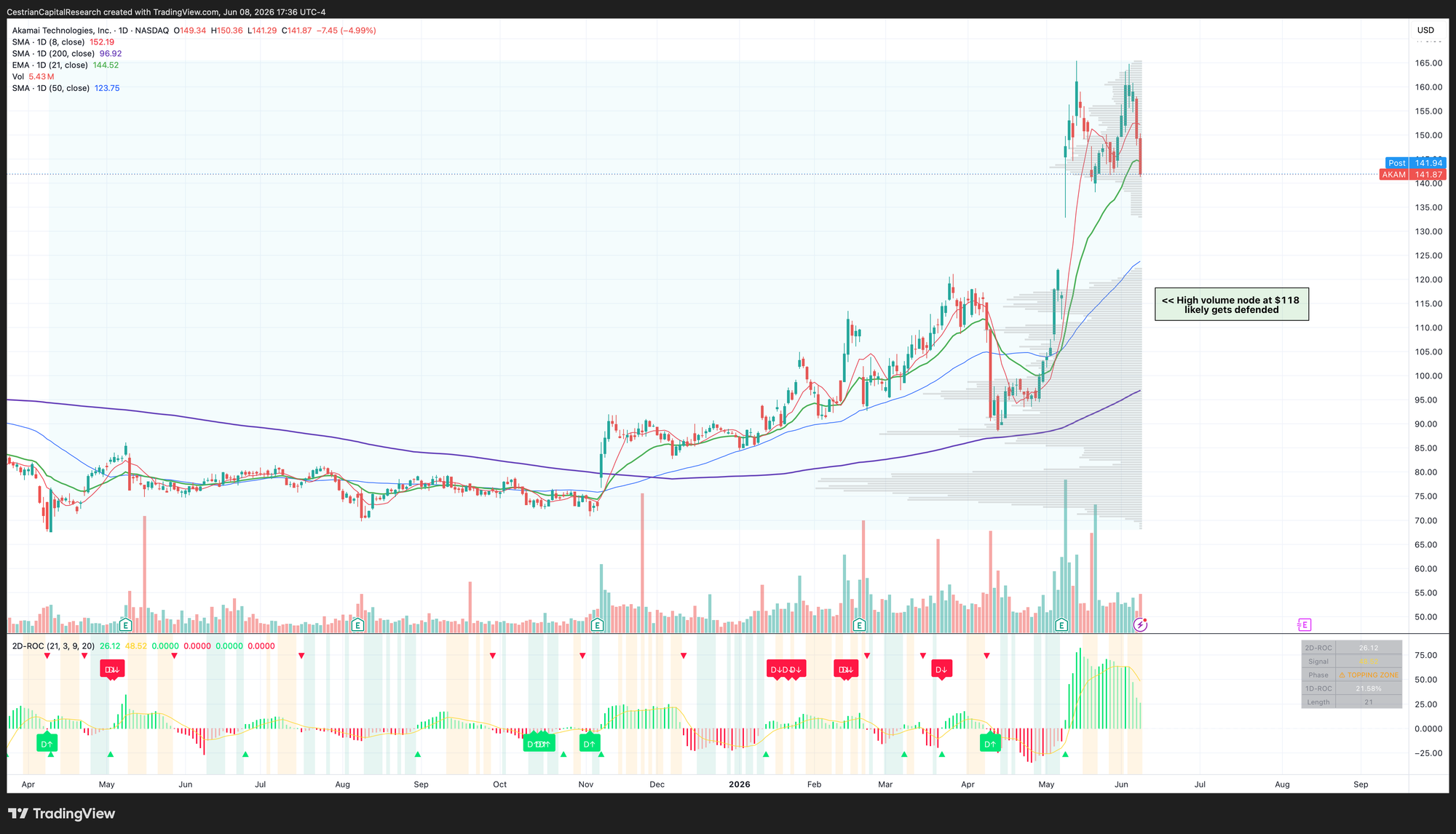
At the moment I don’t think there is a particularly compelling risk/reward balance to enter a long trade. Nearer that $118 volume shelf I could think about opening a long position with a stop a little way into those high volume nodes. Higher up, above the short-term moving averages, I could think about opening a long position with a stop a little below the 21-day EMA. For now I think the stock is in limbo and personally I am just watching it.
Cestrian Capital Research, Inc - 8 June 2026
DISCLOSURE: I am long $NET .