
An Introduction To Microchip Technology ( $MCHP )

DISCLAIMER: This note is intended for US recipients only and, in particular, is not directed at, nor intended to be relied upon by any UK recipients. Any information or analysis in this note is not an offer to sell or the solicitation of an offer to buy any securities. Nothing in this note is intended to be investment advice and nor should it be relied upon to make investment decisions. Read our full disclaimer, here.
by Alex King, CEO, Cestrian Capital Research, Inc, plus Claude CoWork
Background
Much of the semiconductor sector has run already, but there remain some names which have yet to launch, I think. The analog/mixed-signal crowd likely have their best days ahead of them still, since robotics is going to demand a whole lot of real-world interfaces; and other not-household-names like $MCHP also have charts that have yet to moon.
Here’s a take on MCHP, in advance of detailed coverage. The grunt work was done by Claude CoWork in response to my prompts.
Bottom line up front
Microchip is two stories sharing one ticker. The first is a textbook semiconductor cyclical recovery: after one of the deepest inventory corrections in the company's history — revenue fell roughly 40% peak-to-trough — Microchip is snapping back hard, with the March 2026 quarter up 35% year over year and gross margins climbing back toward the company's structural model. The second is a small-but-real AI data-center kicker: a Data Center Solutions unit that did $303m in calendar 2025 and is guided to roughly $500m in 2026, riding PCIe/CXL connectivity into AI server buildouts.
The investment question for the committee is how much of the recovery is already in the price. MCHP screens optically expensive on trough earnings (high-50s EV/EBITDA), but that multiple collapses against normalized earnings power. This is a quality franchise with a wide moat and a credible self-help plan, bought at a point in the cycle where the easy money — the snap-back off the bottom — may already be made. The debate is recovery slope, margin recapture, deleveraging, and whether the AI angle is a needle-mover or a rounding error.
History
Microchip was carved out of General Instrument's microelectronics division in 1989 and IPO'd in 1993. Its defining chapter began in 1991 when Steve Sanghi took the helm and turned a struggling memory and EPROM business into one of the most consistently profitable franchises in semiconductors, built around the PIC microcontroller. For more than two decades the company was a byword for operational discipline: high margins, relentless cost control, and a dividend it raised almost every single quarter from 2002 onward.
The growth engine alongside that discipline was acquisition. Microchip rolled up a long list of embedded and analog businesses — SMSC (2012), Micrel (2015), Atmel (2016, which brought a deep 32-bit Arm microcontroller franchise), and, most consequentially, Microsemi in 2018 for $8.35bn. Microsemi added aerospace and defense, FPGAs, timing, and the data-center connectivity assets that matter to the AI story today — but it also loaded the balance sheet with debt that defined the company's capital allocation for years afterward.
The most recent chapter is the 2024–2025 downturn, which was brutal. A post-COVID inventory glut across industrial and automotive collided with a China slowdown, and Microchip's revenue and margins fell further and faster than most peers. In November 2024 Sanghi returned as CEO (succeeding Ganesh Moorthy), and launched a nine-point recovery plan: shutting the Tempe Fab 2 (~$90m of annual cash savings), slashing inventory, cutting costs, resetting the dividend to preserve cash, and refinancing. FY2026 is the year that plan began visibly working.
Products
Microchip sells "smart, connected, and secure embedded control" — the silicon that runs the unglamorous electronics inside cars, factories, appliances, medical devices, aircraft and data-center plumbing. The portfolio is unusually broad, which is central to the investment case:
- Microcontrollers (MCUs) — the core franchise. Microchip is one of the very few vendors spanning 8-bit, 16-bit and 32-bit (PIC, AVR, and Arm/MIPS-based) parts. The low-end 8/16-bit business is a high-margin, sticky, slow-decline cash machine; the 32-bit business is where unit growth lives.
- Analog and mixed-signal — power management, interface, amplifiers, and signal-chain parts, often sold attached to the MCU as part of a "total system solution."
- FPGAs — the Microsemi/Actel PolarFire family, focused on low-power, mid-range and radiation-tolerant applications (defense, industrial, edge) rather than the high-end data-center FPGAs where AMD/Altera compete.
- Connectivity and timing — Ethernet (including automotive/industrial single-pair 10BASE-T1S up through higher-speed standards), Wi-Fi, USB, CAN, and precision timing/clocks.
- Memory, security, and aerospace/defense — specialty memory, secure elements, and high-reliability components for mil/aero.
- Data Center Solutions — the AI-relevant cluster: Switchtec PCIe switches and retimers, XpressConnect PCIe 6.0 / CXL 3.1 retimers, Flashtec NVMe SSD controllers, and Adaptec storage controllers/HBAs.
The strategic glue is "Total System Solution" — selling MCU, analog, connectivity, memory and software together into a single design — and a "mega-trends" overlay (data center/AI, electrification, sustainability). The economic point is that Microchip's value is less any single product and more the breadth, the ~120,000-customer long tail, and the switching costs of designs that take years to displace.
Market positioning
Microchip's position is best described as the broad-line embedded incumbent for the long tail. It does not chase the leading edge or the largest sockets; it wins on breadth of catalog, supply longevity, design-tool ecosystem, and a sales motion built for tens of thousands of mid-size industrial and automotive customers rather than a handful of mega-accounts. That long tail is the moat: it produces pricing power, stickiness (designs persist for 5–10+ years), and structurally high gross margins (a ~65% non-GAAP target model) — but it also makes Microchip acutely sensitive to the broad industrial and automotive inventory cycle, as 2024–2025 showed.
End-market mix is roughly industrial and automotive heavy, with consumer, aerospace/defense, communications, and a growing data-center/compute slice (management frames data center and compute as about 18% of revenue). Geographically it carries meaningful Asia/China exposure, a double-edged feature given trade and demand volatility there.
Competitors
Microchip competes across overlapping arenas rather than against a single rival:
- Microcontrollers / embedded: NXP, Renesas, STMicroelectronics, Infineon, and Texas Instruments. Infineon leads the global MCU market (~21% share in 2024); the field is fragmented because the variety of parts is enormous. Microchip's edge here is the 8/16-bit long tail and TSS breadth rather than raw share.
- Analog / mixed-signal: Texas Instruments and Analog Devices — both far larger, with deeper analog franchises and (in TI's case) a low-cost internal manufacturing base. Microchip is a strong #3-tier participant, not the leader.
- FPGAs: AMD (Xilinx) and Altera dominate the high end; Lattice competes in low-power. Microchip's PolarFire plays the low-power/rad-hard niches rather than the AI-accelerator high ground.
- Data-center connectivity: Broadcom, Marvell, Astera Labs (retimers/connectivity), and Montage. This is the most strategically interesting battleground for the AI theme — and also the one where Microchip is a smaller, specialist challenger against well-capitalized incumbents.
The takeaway for the committee: Microchip is rarely the #1 player in any single category, but its combination of breadth, reliability and margin discipline gives it a defensible aggregate position that is hard to replicate and harder to displace.
Summary financials
The headline numbers tell the recovery story clearly. Microchip is profitable, cash-generative, and inflecting upward — but off a depressed base and with a balance sheet still carrying acquisition debt.
- FY2026 revenue: $4.713bn, +7.1% year over year — but the trajectory matters more than the level. The March 2026 (Q4) quarter was $1.311bn, up 10.6% sequentially and 35.1% year over year, above guidance.
- Margins: Q4 non-GAAP gross margin 61.6% (after ~$47m of underutilization charges) and non-GAAP operating margin 30.6%, both recovering toward the company's ~65% GM / high-30s% operating model as fabs re-load.
- Earnings: FY2026 non-GAAP EPS of $1.64; Q4 non-GAAP EPS $0.57. These are trough-to-recovery numbers, well below mid-cycle earnings power.
- Guidance: Q1 FY2027 (June quarter) revenue of ~$1.442–1.469bn (up ~35% year over year, ~11% sequentially), with non-GAAP gross margin guided to ~62.25–63.25% — i.e., the recovery is expected to continue.
- Cash returns: ~$984m returned via dividends in FY2026, with a $0.455 quarterly dividend (~$1.82 annualized, ~2% yield). Note the payout exceeded trough non-GAAP EPS — a ratio the recovery now needs to grow back into.
- Balance sheet: still carrying several billion of net debt from the Microsemi era. Microchip issued $800m of 0% convertible senior notes due 2030 in February 2026 and has made debt reduction the explicit capital-allocation priority as operating cash flow resumes covering debt service and the dividend.
- Self-help: the Fab 2 closure (~$90m annual cash savings, P&L benefit from the June 2026 quarter) plus the nine-point plan underpin the margin-recapture path.
Valuation
On trailing trough earnings, MCHP looks expensive — roughly high-50s EV/EBITDA and a P/E in a similar zone — at a market capitalization around $48.6bn. Those multiples are a cyclical artifact: the denominator (earnings) is depressed, not the numerator inflated. As with all cyclical plays, at the right inflection point in earnings, the buy point is a high p/e and the sell point a low p/e. (Micron shareholders take note!).
The more useful lens is normalized earnings power. At a recovered ~65% gross margin and high-30s operating margin on a mid-cycle revenue base, Microchip's earnings power is multiples of the FY2026 $1.64, and the forward multiple compresses sharply as the recovery flows through. Relative to peers, MCHP sits at a premium to Texas Instruments (~20x EV/EBITDA) and Analog Devices (~32x) on current numbers — but that premium is almost entirely a function of where each sits in its own earnings cycle, not a clean quality comparison. The right framing for the IC is a normalized P/E and EV/EBITDA on FY2028 mid-cycle estimates, and a judgment on whether the recovery slope justifies paying up today.
The bull case: you are buying a high-moat compounder mid-recovery, before mid-cycle earnings reset the multiple lower. The bear case: the snap-back is well understood and largely priced, the dividend currently out-earns the company, deleveraging will absorb cash that might otherwise fund buybacks, and any stumble in the industrial/auto recovery re-rates the stock quickly given how much optimism the current multiple embeds.
Fit with the AI buildout theme
This is the question that has re-rated the stock, and it deserves a precise, unhyped answer. Microchip is not an AI semiconductor business in the Nvidia/Broadcom/Marvell sense — it sells no accelerators and no high-end training silicon. But via the Microsemi data-center assets it has a genuine, growing attach to AI server buildouts, and the market has noticed: MCHP shares jumped ~14% on the disclosure of data-center revenue detail.
The substance: Microchip's Data Center Solutions business generated $302.7m in calendar 2025 and is guided to roughly $500m in calendar 2026 — about 65% growth — across three product families: PCIe/CXL switches and retimers (Switchtec, XpressConnect), Flashtec NVMe storage controllers, and Adaptec storage/HBA. The newly launched PCIe 6.0 and CXL 3.1 retimers target exactly the signal-integrity and latency problems that proliferate as AI servers pack in more GPUs and memory. As accelerator counts and PCIe lane budgets explode inside AI racks, the demand for retimers, switches and high-speed connectivity scales with them — a real, if picks-and-shovels, exposure to the buildout. Management frames the broader data-center/compute end market at roughly 18% of total revenue.
For context, at ~$500m guided for 2026, Data Center Solutions is roughly a tenth of group revenue, growing fast but starting small, and competing against Astera Labs, Broadcom and Marvell in connectivity — better-funded specialists in exactly this niche. So the AI angle is a legitimate growth vector and a reasonable sentiment catalyst, but it is not yet large enough to be the thesis on its own. The dominant driver of MCHP earnings over the next 12–24 months remains the cyclical recovery of its core industrial and automotive MCU and analog business; the AI data-center kicker is a genuine sweetener and an option on a larger future position, not the main event.
Conclusion
Microchip is a high-quality, wide-moat embedded franchise emerging from a savage downcycle with a credible self-help plan, recovering margins, and a small but fast-growing AI data-center business that has captured the market's imagination. None of that is in dispute. The fundamental investment decision turns on price and timing: the snap-back off the bottom is well advanced and the stock embeds a confident recovery, so the asymmetry that existed deep in the trough has narrowed.
MCHP Stock Chart
Here’s how the chart looks to me.
The stock tested its 50-day SMA today and found support. It looks as though the price may be bottoming here based on our early-stage, unproven 2nd derivative indicator.
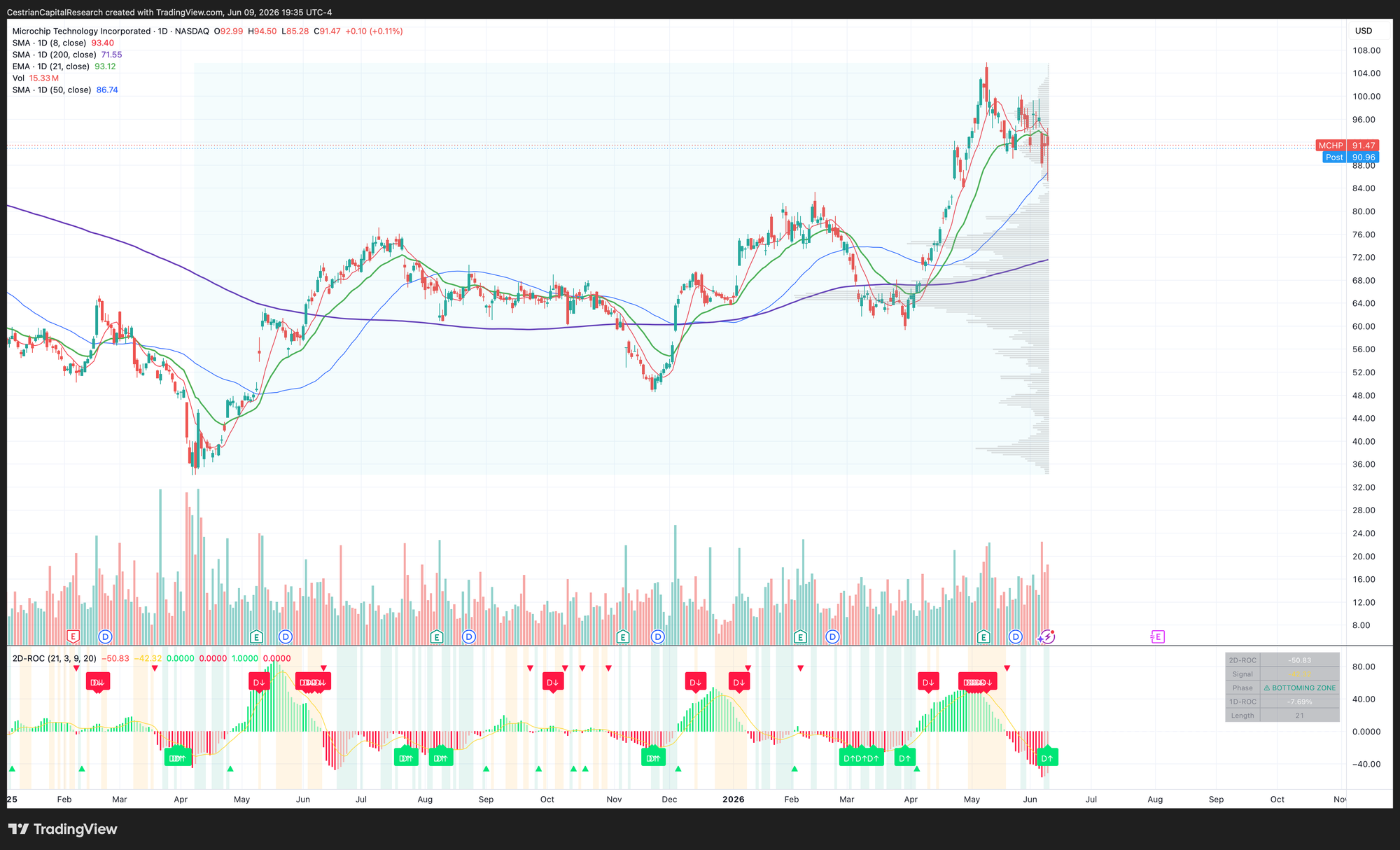
If I were to open a position, which I am considering but have yet to execute, I would likely want a trailing stop starting a little below today’s intraday lows - that means around a 7% trail. I would decide the maximum amount of capital I was prepared to lose on this trade - we can call that Lmax - and I would calculate my allocation size as: LMax / 0.07 = Allocation. My long trade would be subject to that 7% trailing stop.
We’ll cover this one properly soon but I hope this was a useful note.
Cestrian Capital Research, Inc - 9 June 2026