
Hyperliquid: Everything Is Shifting Under The Surface.

DISCLAIMER: This note is intended for US recipients only and, in particular, is not directed at, nor intended to be relied upon by any UK recipients. Any information or analysis in this note is not an offer to sell or the solicitation of an offer to buy any securities. Nothing in this note is intended to be investment advice and nor should it be relied upon to make investment decisions. Read our full disclaimer, here.
Market On Open, Wednesday 1 April
by Alex King, CEO, Cestrian Capital Research, Inc.
Nothing is safe from the deflationary power of technology. The reason that billionaire tech bros are a thing is that as founders of powerfully deflationary businesses, their shares accrued value that previously showed up in the real economy as high margins for guild-type business operations. Google’s founders have purchased large parts of the US using money that once showed up in Yellow Pages cashflows. Thomas Peterffy is a top-50 billionaire as a result of money no longer paid in commissions to stockbrokers on the phone. That money has accrued to Interactive Brokers’ stock price and, thus, to Mr. Peterffy’s pocket.
The deflationary force that has been ever-present in computing since its dawn took an order-of-magnitude step up with the proliferation of the open Internet. With ubiquitous TCP/IP over Ethernet came distribution costs trending towards zero. And with the advent of agentic AI - specifically agentic AI, not the chatbot, but the ability of an LLM to receive instruction and translate that into an electronic and ultimately physical action - comes the next order-of-magnitude deflation. There is a reason that white-collar workers everywhere are scrambling to upskill. Because their choices are: upskill and leverage the new, or, sit tight with an active goal to collect severance thus to fund a different life direction, or, asleep at the wheel.
It’s not just workers though. Also in the sights of tech are the many, many remaining guilds. If you see a monopoly anywhere, with the high margins and captive customer base typical of such an enterprise, someone is gunning for it. In the 1990s and 2000s, many new stock-trading venues were established now that the Internet could handle it all and you didn’t have to be a member of the right coffee-house fraternity that had been establised in 1765 as long as you had money. Right now, futures exchanges are next, with the CME being the first fattened calf on deck.
Hyperliquid ( HYPE ) is a business of the moment. This is a trading venue offering “perpetual futures” which have no expiry date or, as a result, roll costs. Money is made on the contracts via the delta to spot, by way of a funding rate, fees paid from long to short holders depending on whether the contract is trading above or below the spot price of the underlying. Like your grandparents’ futures, they come with leverage big enough to destroy you if you are careless. Unlike your grandparents, they never sleep. Hence the moniker. Lest you think that this is purely a degenerate Chad type play, note that perpetual oil futures hit $1.7bn in daily volume on Hyperliquid at one point during the current war. Institutional money will continue to seek out liquidity in my view, not least because if 24/7 stock trading becomes a thing, market makers will need to be parceling out risk 24/7 too, and if the CME is closed they can’t do that. Will the CME die? No. After all, the London Stock Exchange is still a thing. Looks a little different now to the 18th Century, but it is still a thing. But will Hyperliquid take share? And will the spoils accrue to its founders? I think it will.
The company, by the way, is also a modern beast. The legal entity is HQd in the Caymans, operations take place in an AWS instance in Tokyo (which Claude tells me means 100x less latency to Japanese traders vs. those in the US or Europe), its founders are from the US, and the focus of spending is in lobbying DC as you would expect. It runs on a proprietary blockchain database.
You can trade HYPE on a number of the crypto exchanges. Here’s how it’s doing.
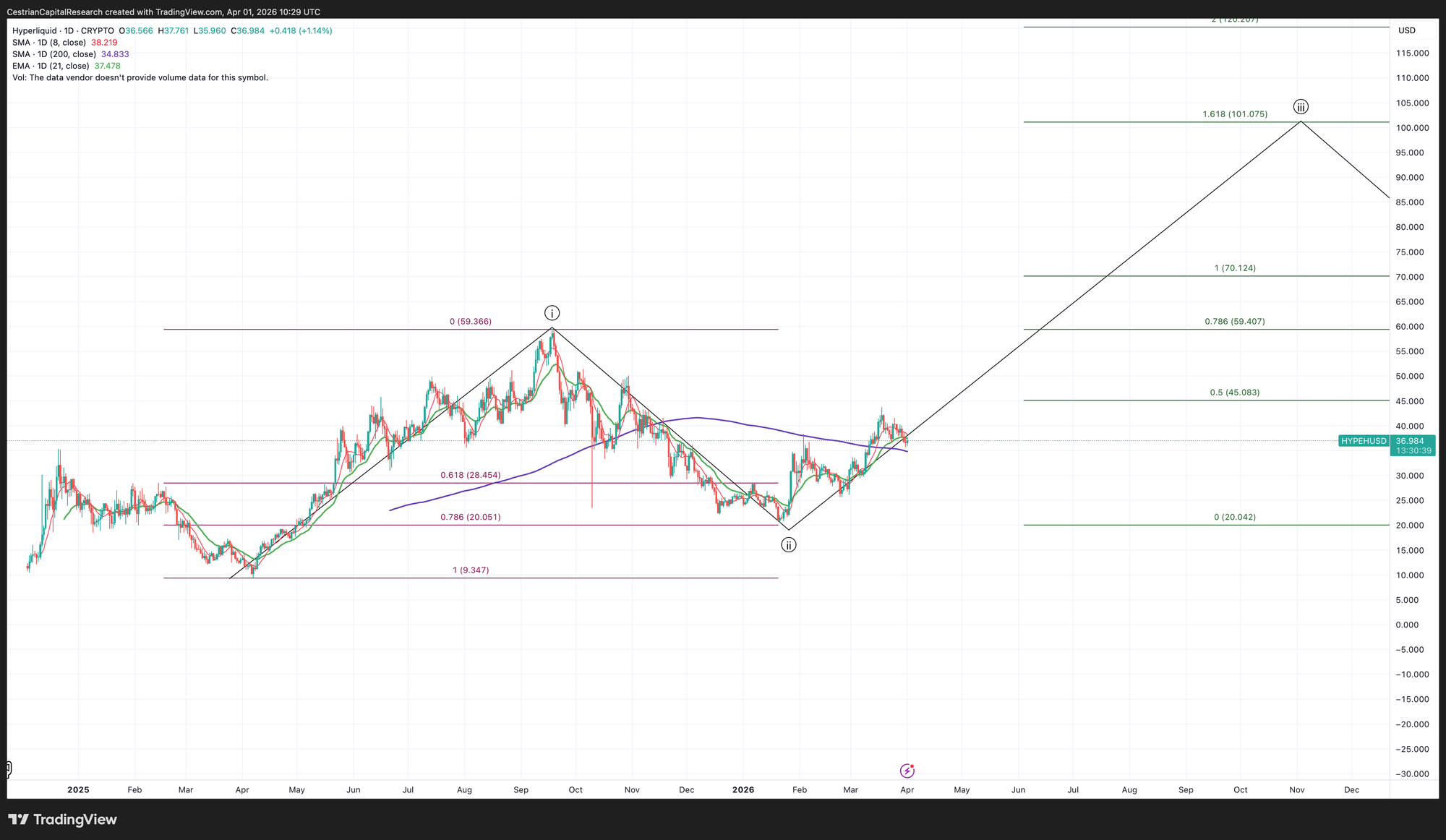
So far so early, but interesting to note the recent pullback found support at the .786 retrace of the move up to the highs. This is a common pullback support level and it implies that similar trading methodologies are applied to $HYPE as to the S&P and other boomermaxxed tickers.
I’m GenX and so crypto exchanges scare me. So I want a little exposure to HYPE but I don’t want my capital to be the next Mt. Gox, 2026 Edition headline. Instead I own a stock, $PURR, which is a single-asset treasury company which owns HYPE.
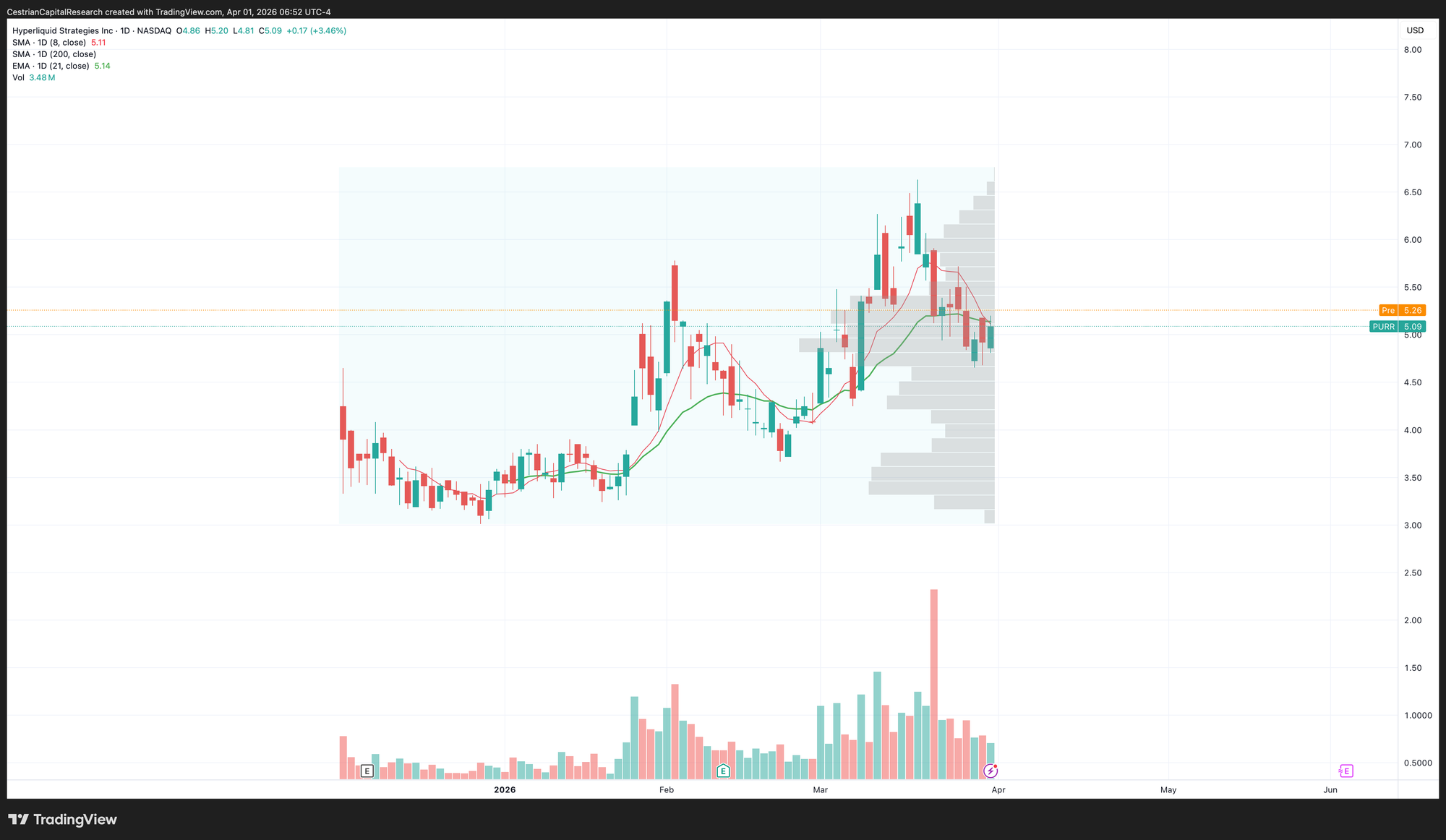
This too is imperfect for many reasons but with a modest allocation to see what happens, I recently took the plunge. Because I never did like sitting around with my head in the sand and I have seen enough bulldozers destroy the old guard to want a little exposure to one that may be the next.
Disclosure: I am long $PURR.
LIVE WEBINAR, TOMORROW, ALL WELCOME: Is Software Dead?
Join us live on Thursday 2 April at 1430 Eastern to find out. Live webinar, here.
We’re Here To Help
We serve thousands of professional and independent investors every day.
If you have any questions whatsoever about our work or how to use it, please reach out anytime.
You can contact us at minerva@cestriancapital.com or by using this contact form.
Yes But What About Those Boomer Stocks And Stuff?
Let’s check in.