
The Future Of Software, And How To Spot The Companies That Grasp It - The Cestrian Circle Newsletter

DISCLAIMER: This note is intended for US recipients only and, in particular, is not directed at, nor intended to be relied upon by any UK recipients. Any information or analysis in this note is not an offer to sell or the solicitation of an offer to buy any securities. Nothing in this note is intended to be investment advice and nor should it be relied upon to make investment decisions. Read our full disclaimer, here.
Software Is Dead.
by Alex King, CEO, Cestrian Capital Research, Inc
First a little context. I have studied, watched, invested in and occasionally even written software for about forty years, the writing part being undertaken on a then-groundbreaking low cost home computer with 48K in RAM, and the investing part across venture capital, leveraged buyouts and then for the last decade or so, public stocks. And what I can tell you from this lengthy period of time is that nothing is ever on solid ground in software. There is always a new way of doing things coming down the pike. And the old guard - those who have only the ability to protect what they have rather then to embrace and leverage the new - they always decry, deny, undermine and generally naysay what is to come. The old guard is always wrong. Usually they look like they are right for a time, because change is always slower than enfant terrible vendors hope for, but they are always wrong.
Anyone who tells you that enterprise software will survive the advent of agentic AI unscathed or in only slightly modified form is wrong. Whatever their argument - that enterprise customers won’t trust their systems of record to agents, that the embedded workflows in existing applications can’t be replicated, that user interfaces are part of the furniture and too risky or expensive to rip out, any of this reactionary nonsense, they’re wrong.
A little historical context.
- In the early to mid 1990s, software vendors selling to banks’ trading desks generally ran on Sun Microsystems SPARC workstations running Solaris, a Unix variant. With good reason; performance and uptime and form factor were best in class. When trading systems came along that ran on Linux or Windows, the McNealy Cult Army spent a good five years explaining how all these new things were insufficiently reliable, too slow, etc. From about 2002 onwards, the blue boxes started to disappear to be replaced by faceless boxes running on, yup, Linux or Windows.
- In the late 1990s and early 2000s, enterprise software at large was predominantly client-server in nature. Computing logic was executed on client devices to a large degree, whilst data and process flows were held on the server side. Typically the network used to connect client and server devices was proprietary to the corporate customer and interacted seldom with the open Internet, for reasons of data security and connection integrity. When software-as-a-service started to rear its head in the early 2000s, anyone who was anyone would tell you that SaaS could never succeed because (i) customers would not use the open internet for their sensitive data (ii) customers would not use multi-tenanted database architecture where one instance held information from many customers (iii) customers would never move their complex processes from incumbents like Siebel Systems to new players like Salesforce. OK. Anyone heard from Siebel Systems lately? Thought not.
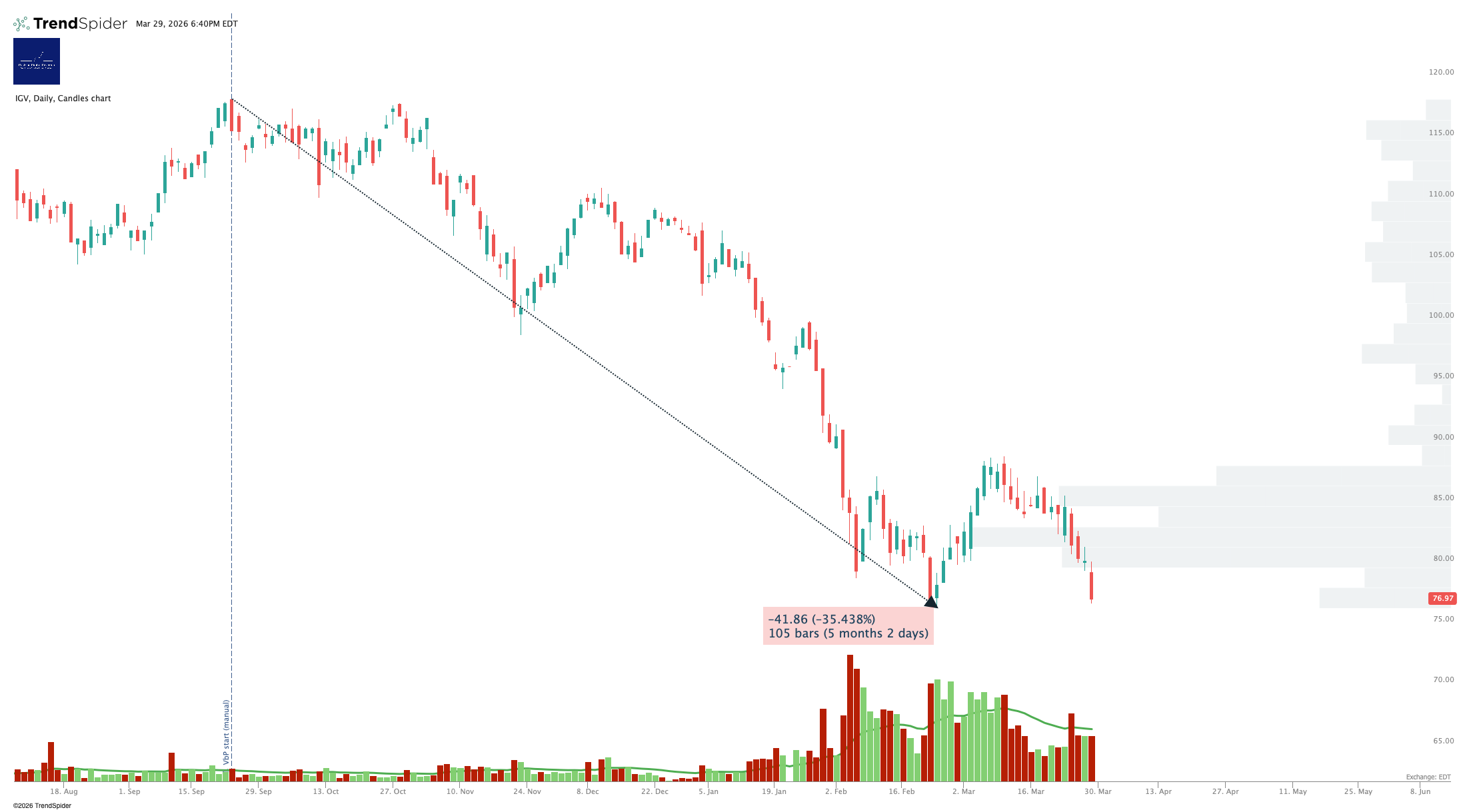
Today the heralds of destruction are telling you that enterprise software is dead, killed by the successful abstraction of binary logic from natural-language input, thus eliminating the need for conventional software development. Coders are now on the scrapheap next to coalminers and shipbuilders, it seems. This logic lies beind the value destruction in software in the last year. The more people use Claude, the more people believe the End Of Software is up on us.
Long Live Software!
The other camp, the refuseniks and naysayers, are telling you that customers will never move to some kind of vibe-coded apps because they would imperil their systems of record, risk their processes being decomposed, and surrender the comfort of a maintenance agreement with a big dog like Salesforce in exchange for relying on Jay and Silent Bob who joined last week to ship the new CRM system next week, all whilst also working their side hustle from home.
Both these groups are wrong. Software is going to change in remarkable ways, and any vendor who doesn’t keep up is going to be left behind. But software, grownup software, isn’t going to be vibecoded.
Software, eating the world for so long now, has now started to eat itself.
The software vendors who will survive and thrive, I believe, are those who cannibalize their own operations using AI. To succeed this has to start with a religious level of belief at CEO level. The CEO has to be the #1 AI zealot in the company. And use this zealotry to (i) eliminate any position that can be eliminated by AI today (ii) block the hiring of any new heads into roles that AI could fulfill and (iii) explain this fervor to all constituents, not least sellside analysts and investors.
Executed correctly this will see such software companies be able to grow revenue at the prevailing rate or better, but grow costs much more slowly and perhaps achieve a structural upgrade in cashflow margins as a result. Better, since the lack of humans means a reduction in the amount of stock-based compensation required, these companies should see rapid earnings per share growth because (i) earnings are growing fast after RIF and (ii) the number of shares is lower than would previously been the case.
How To Pick A Winning Software Stock
I believe the answer is in the numbers. Personally I will be looking for:
- Order book growing fast than revenue
- Cashflow margins improving at some pace, faster than revenue
- Earnings per share increasing faster than revenue as stock-based compensation falls as a % of revenue
- Balance sheet strengthing
And much more, as we discuss in our Inner Circle chat all day long.
Join Us To Talk Software LIVE!
Our live webinar, Is Software Dead, is THURSDAY 2 APRIL at 1430 EASTERN. Register here.
Appendix: Software Candidates To Watch
Salesforce (CRM) — ~$300B market cap
The most vocal example. CEO Benioff announced in early 2025 that Salesforce would hire no new software engineers that year, stating engineering productivity had increased more than 30% through Agentforce and internal AI tooling. In September 2025 he confirmed approximately 4,000 support role cuts, saying bluntly that he needed "less heads" because AI agents now handle roughly 50% of customer interactions. In February 2026 a further ~1,000 roles were cut. Simultaneously, Salesforce hired 1,000–2,000 salespeople to sell Agentforce — so the mix shift is explicit: fewer engineers and support staff, more quota-carriers selling the AI product itself. This is the clearest example of the thesis: use AI to cut the cost base, then redeploy savings into revenue-generating roles.
Block (XYZ, fka Square) — ~$25B market cap
The most dramatic single action. In February 2026, CEO Jack Dorsey cut approximately 4,000 employees — nearly 40% of total headcount — explicitly citing AI. The company's AI-powered customer service systems were resolving 70–80% of inquiries without human intervention. CFO Amrita Ahuja framed it as an opportunity to "move faster with smaller, highly talented teams using AI to automate more work." The stock surged over 20% on the announcement. Dorsey predicted most companies would make similar cuts within a year. The market is now watching quarterly opex run-rate and gross profit per employee as proof points.
Shopify (SHOP) — ~$130B market cap
CEO Tobi Lutke published an internal memo in April 2025 mandating that before any team can request new headcount, they must first demonstrate that AI cannot do the job. AI usage is now factored into performance reviews. Lutke wrote that he'd seen employees use AI to accomplish tasks that would previously have been implausible, getting "100X the work done." This isn't a layoff story per se — it's a hiring-gate story. No specific headcount numbers were disclosed, but the policy effectively caps organic headcount growth at zero unless the AI test is failed.
Duolingo (DUOL) — ~$15B market cap
CEO Luis von Ahn announced in April 2025 that Duolingo was going "AI-first." The company phased out contractors (translators, then writers) starting in 2024, with a 10% contractor cut in 2024 followed by further reductions. The productivity metric is striking: creating language courses that previously took a decade can now be done in under a year — the company built 148 AI-written courses in less than a year. Von Ahn claims AI makes full-time employees four to five times as productive, and notably the company has not laid off full-time employees — it grew full-time headcount while slashing contractors. This is the "grow revenue without growing costs" version of your thesis rather than the "cut costs" version.
Workday (WDAY) — ~$75B market cap
Cut 1,750 jobs (roughly 8.5% of workforce) in February 2025, with CEO Carl Eschenbach citing AI in the restructuring announcement. The company's own Illuminate AI agents are being deployed internally, with early adopter metrics showing recruiter capacity up 54% and FP&A efficiency up 49%. Another 14 AI agents planned for 2026. Workday is interesting because it's both a vendor building AI agents for customers and a company using its own product to reduce its own headcount.
Intuit (INTU) — ~$180B market cap
Cut ~1,800 roles (10% of workforce) in July 2024, but simultaneously committed to hiring 1,800 new people with AI/engineering skills, expecting overall headcount to grow. CEO Sasan Goodarzi positioned this as a skills rotation rather than a net reduction. The key distinction: Intuit claims it doesn't do layoffs to cut costs. This is the "same headcount, different skills, higher revenue per head" variant.
Dropbox (DBX) — ~$8B market cap (slightly under your threshold)
Worth including because of the explicitness. CEO Drew Houston cut 16% (500 people) in April 2023 citing AI, then cut another 20% (528 people) in October 2024. Over 1,000 total jobs eliminated across both rounds. Houston said the company needed a different skills mix, particularly in AI and early-stage product development. SEC filings show restructuring charges of $37–42M for the first round and $63–68M for the second.