Toss Your Thesis. Make More Money.

DISCLAIMER: This note is intended for US recipients only and, in particular, is not directed at, nor intended to be relied upon by any UK recipients. Any information or analysis in this note is not an offer to sell or the solicitation of an offer to buy any securities. Nothing in this note is intended to be investment advice and nor should it be relied upon to make investment decisions. Read our full disclaimer, here.
by Alex King, CEO, Cestrian Capital Research, Inc
I find myself writing some version of this a lot through each week, in part because I think it’s literally the most important lesson one can learn in investing and trading, and in part to keep drumming it into my own brain.
- No-one cares about your opinion
- Your thesis doesn’t matter
- Only price matters
Now, at present there are very clever people all over the world losing their minds over what they believe to be two impossible situations. First, the SpaceX IPO and second, the oil price.
$SPCX - The Shouldn’t Be Happening Moonshot
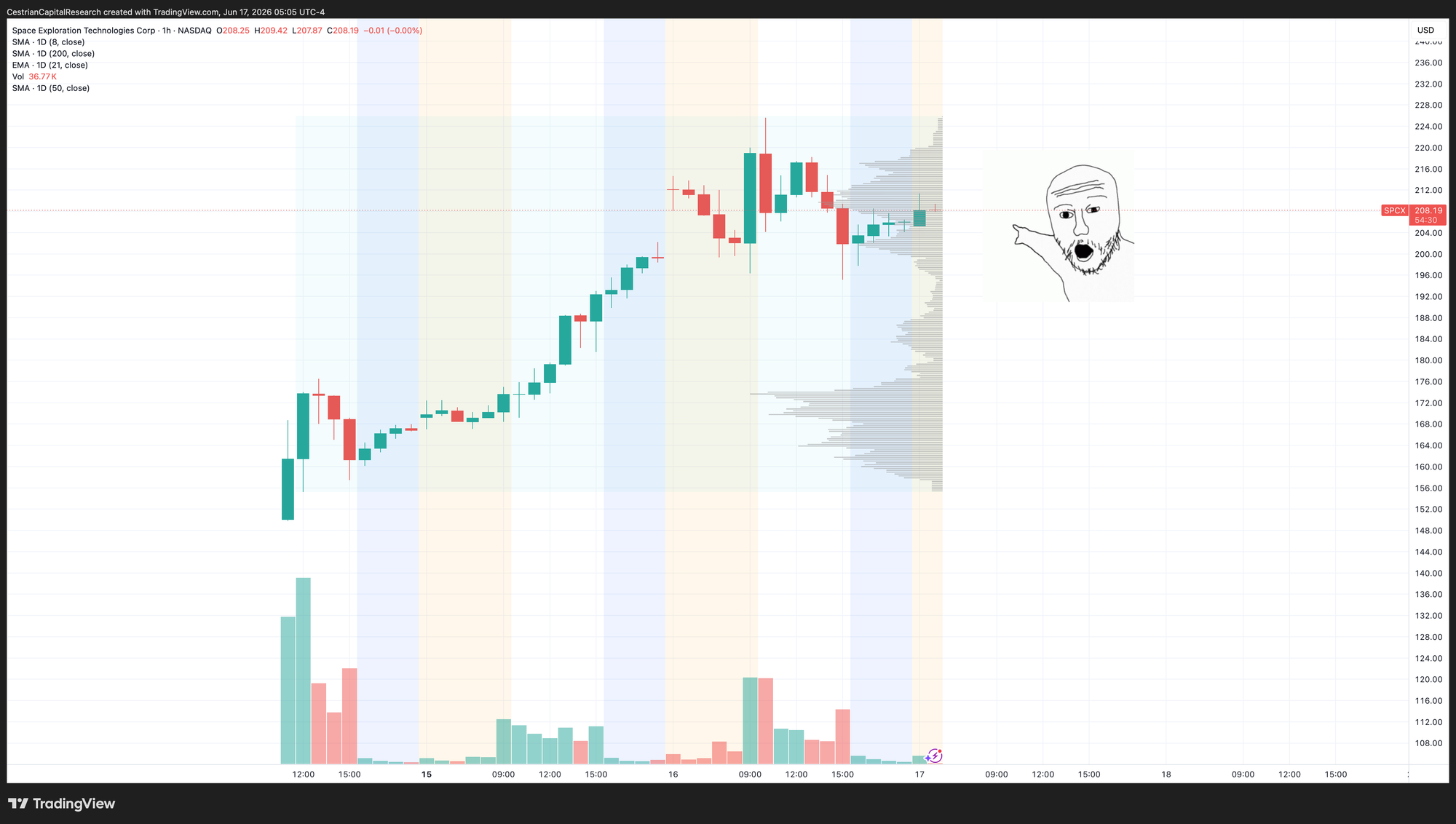
The SpaceX $SPCX IPO has been a big success, as judged by the stock performance from pre-IPO pricing through the opening of trading to the current price. Which has caused a lot of otherwise sensible people to have a breakdown.
“It’s a scam!"
“Biggest fraud on Wall Street!"
“How can it ever be worth that?"
Look, the stock market is a game. An infinite game. The biggest MMORPG that ever was. And each stock and ETF has its own subgame. If you want to make money from a particular stock or ETF, you need to get good at playing that game.
If for instance you continually try to assess Tesla Motors vs. other automakers then you will fail at the game called $TSLA, because the game called $TSLA is almost entirely unrelated to the company called Tesla Motors. The game called $TSLA has its own internal logic to do with a charismatic CEO, a shapeshifting ability to fit into the dominant narratives at work amongst the wealthy (meaning those wealthy enough to buy either a Tesla Motor or a $TSLA share), the options market, and so on and so forth.
Likewise, if you try to think about why the company called SpaceX is today worth more than the company called Amazon, you will fail if your thinking has to do with revenue, profitability, market size and blah.
The $SPCX IPO is a success so far because:
- With plenty of evidence in support of their opinion, a lot of people believe that Elon Musk can conjure up investment gains for other people out of thin air and want to buy into the game.
- There is a tiny free float and no-one is selling yet, because Elon (retail) and because insider lockup rules (staff) and because underwriter rules (institutions).
- There is a wave of buying coming as the stock will be included in the Nasdaq index in short order, and everyone knows this.
Those are the current boundary conditions of the game called $SPCX at present. These boundary conditions will change when lockups expire, once the index buying is done, if something else happens out of left field. And then new boundary conditions will apply.
Oil Wait Wut

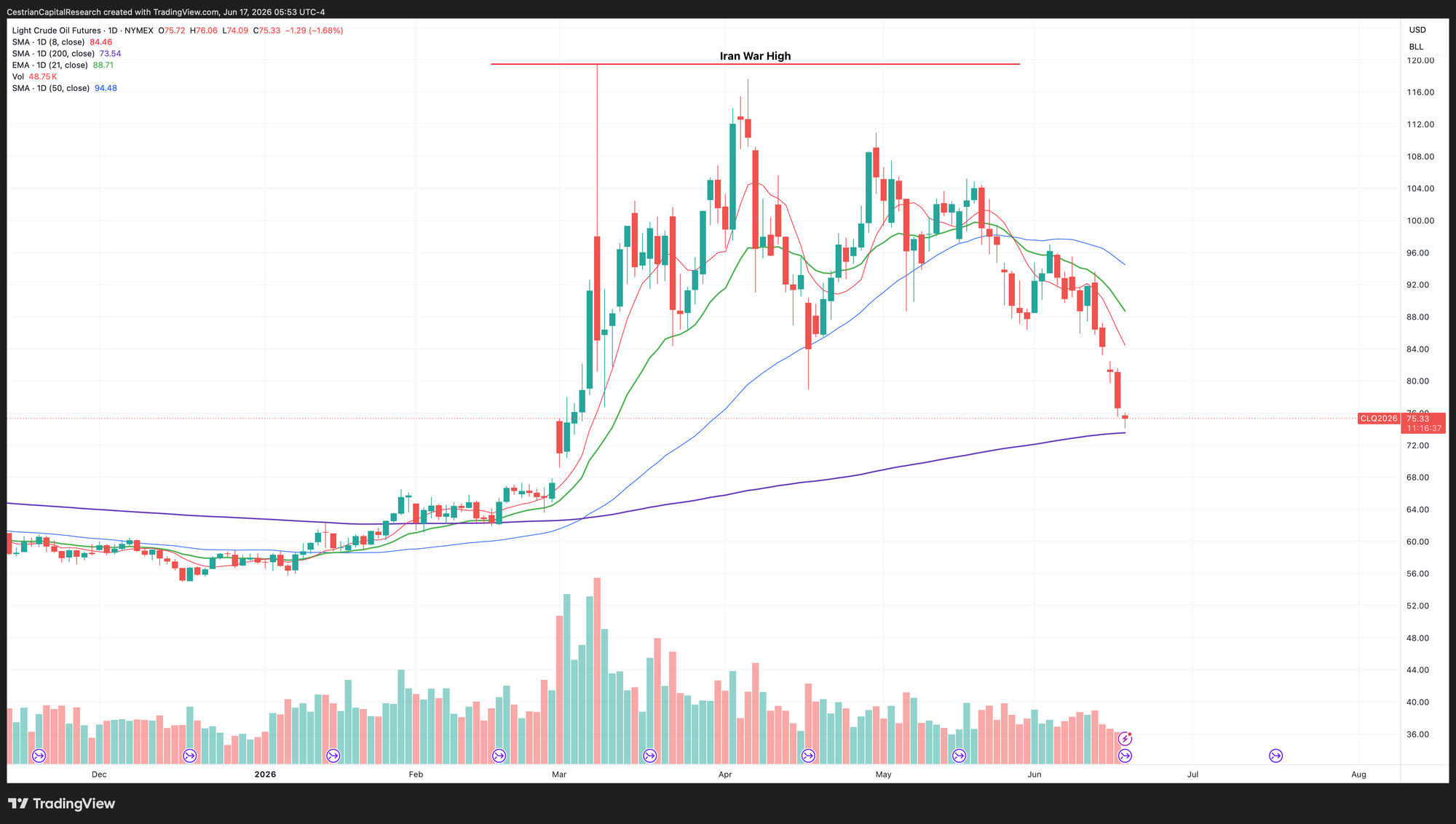
See those two images can’t both be true, can they? Oil extraction, refinery and transit facilities offline worldwide - in Russia as well, remember, not just the Gulf - but oil futures sat on the 200-day moving average as if the whole thing has been just a fever dream.
Cue the outrage:
“It’s a scam!"
“Biggest fraud on Wall Street!” (again! - lot of these around)
“How can it only be worth that?"
Except these two images are both true. The rules of the game in oil are a little less clear than the rules of the $SPCX game, at least to me, but then I am no oil analyst. I do know that trying to build a 20,000 line model to work out what oil should be worth based on Cushing tank levels, presupposed assumptions about consumer behavior as regards filling their tanks or using EVs instead, or any other IRL thing, has not been successful. And a lot of very smart people are losing an awful lot of money trying to solve for the oil price this way.
How To Win At Any Ticker Game
The First Rule Of Success is, forget fundamentals if you are playing publicly-traded securities ticker games aka investing or trading the stock market. Fundamentals are useful for all manner of things but this is not one of them. Fundamentals are only tangentially related to price and, I am willing to bet and in fact often do bet that fundamentals have no predictive power of price whatsoever. You want to talk about credit, different story. Private, untraded equities, different story. But public markets? Pshaw. Grow up.
Look, your job as a public market investor is not to construct 20,000 line DCF models to work out what the price will be in twenty years. That is a waste of CPU cycles, your own and your computer’s. Your job as an investor is to work out, well, can I figure some of the rules of the ticker-games I am playing right now, or ones I want to play in the future, and win at them.
The Second Rule Of Success is, realize that you cannot know all the rules of each ticker game. If you like, you can spend your life trying to work out the rules of each game, but you will fail, because you don’t and can’t occupy the Olympian viewpoint. Perhaps Citadel or Jane Street get the best view but even then, they can’t see the whole picture.
But there is a toolkit though that gives you the best view available, albeit one with several layers of abstraction between you and reality. And it is called a stock chart. A stock chart tells you where price and volume have been in the past. For all practical purposes, price and volume in the future are best predicted by where price and volume have been. Price and volume as a practical matter can be treated as a closed system. In reality it is not, in fact, closed, since external factors do drive both variables, but since we cannot see each of those external factors quickly enough nor predict the impact on price and volume, we are better to treat the system as closed and self-referential. The reason that hidden Markov models and such things are useful is because we cannot see reality clearly enough nor quickly enough, so we have to find proxies for it.
The Third Rule Of Success is, develop a detailed toolkit which enables you to play each ticker game according to certain boundary conditions. Let’s take a very simple one - the 200-day simple moving average. You see that oil chart above? Personally I opened a small long position in oil this week because I am guessing that the 200-day will hold as a boundary condition. If it doesn’t, and oil drops down through the 200-day, I shall sell the position at a small loss, because I was wrong. If the boundary condition holds, and oil starts to move up, then I may add to the long oil position, but always with a trailing stop so that if I am wrong, I don’t cost myself too much money. You see? Like that. It is interesting to note that Cushings is at its lows and the oil price is on the floor, but so what? How does that help me make more money or lose less money? It does not.
Your Thesis Is Costing You Money
Theses about a stock are interesting, if you like rabbitholes (and I do). They play a big part in capital raising in institutional markets, and the form the basis of narratives generated and promulgated in markets by those capable of moving price. But your thesis as an investor, whether you are running $10bn+ of institutional capital or a rather smaller chunk of your own, is bunk.
Get over yourself.
Grow up.
Learn to spot the boundary conditions in the game of each ticker you choose to play, and proceed accordingly. I can tell you it will raise your own game no end. Your family and/or your investors will thank you for this.
Ways To Raise Your Game
Whether you run money professionally or as a side hustle, read our stuff. We teach the fine art of Spotting Boundary Conditions all day long. And if you want a machine to do that for you, we have machines that will do so. Purely quantitative machines, cross-asset machines, all kinds of machines. Our work sits behind the success of RIAs, funds and independent investors alike.
If there is something in particular we can help you with, drop us a line here.
Cestrian Capital Research, Inc - 17 June 2026.