
This Week’s Trades And Webinar (The Cestrian Circle Newsletter)

DISCLAIMER: This note is intended for US recipients only and, in particular, is not directed at, nor intended to be relied upon by any UK recipients. Any information or analysis in this note is not an offer to sell or the solicitation of an offer to buy any securities. Nothing in this note is intended to be investment advice and nor should it be relied upon to make investment decisions. Read our full disclaimer, here.
by Alex King, CEO, Cestrian Capital Research, Inc.
Over the years we have developed a pretty rigorous method for sector and stock selection, and as time passes we try to improve the approach both stepwise and, sometimes, by adding entirely new methods into the mix.
At the core of the Cestrian method is Wyckoff Rotation - the notion that market-moving asset managers rotate capital into a sector and its stocks at the lows, quietly; hold whilst the “good news stories” about the sector and its stocks start to break, and sell gradually as everyone and their pet pig becomes way bullish on the sector or stock. You can apply this motif to most any timeframe but we find it works best over a year or more of elapsed time. No method is perfect of course, but often enough it helps us spot institutional accumulation in a “hated” sector (meaning a sector where there is a negative narrative infecting discourse and, indeed, Discords), markup whilst the good news stories break out, and then institutional distribution into strength as late money arrives to buy the top of the trend.
In recent months no sector has been more hated than software. You have not been able to move or breathe without tripping over this kind of thing:

The thing about watching rotation though is that when you see prices in a sector flattening out whilst the deluge of negativity continues to flood your timeline, inbox and Substacks, you can start to get fairly confident that Big Money is flowing into the sector. And you can start to measure it. Which means you can start to build a position or positions in the sector (by way of sector ETFs) or its constituent parts (by way of single name stocks). And since this is likely to be near local lows, you can set a stop which is not too far south of spot, which means that if you are wrong, the damage is going to be limited. But if you are right … well, you’re going to find yourself ahead of the pack, out there on the edge where you gotta be, and then once you’ve built a position over days or weeks, along soon enough will come the furu-inspired hordes to bid up your buy.
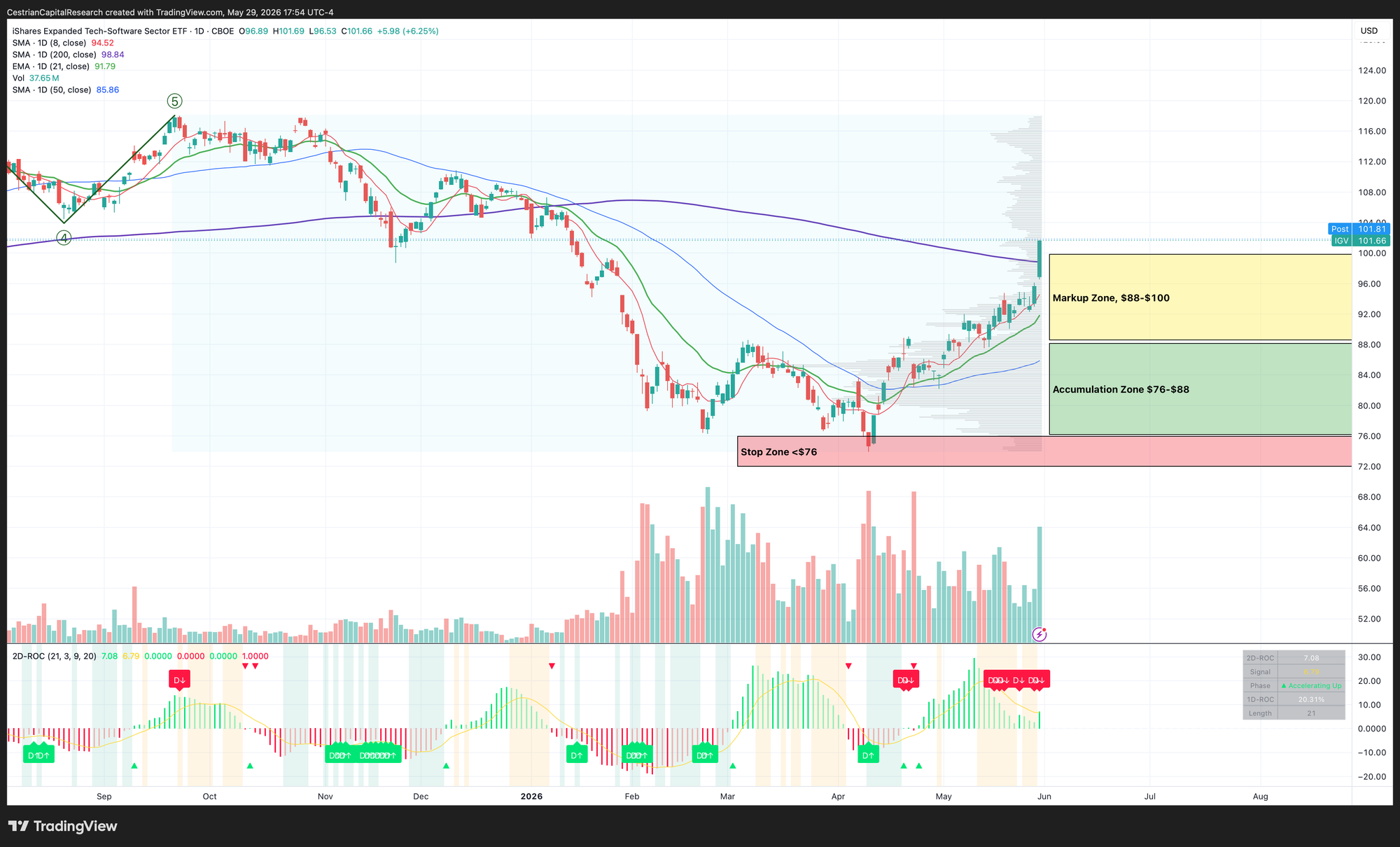
Today you have half the Internet saying, oh wow software is hot again! Buy! But because they are being led to water, they are already late. Today the late money was buying the software sector ETF, $IGV, in the Markup Zone. Whereas anyone using the Cestrian methodology would have been buying in the Accumulation Zone (between $76-$88) - somewhere between 14-25% lower than the late money heroes (who by the way think they are early).
Here’s the IGV chart.
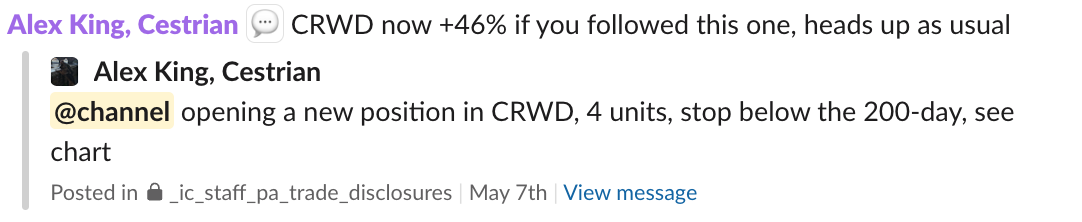
Buying into a sector early means you get the jump on buying into single name stocks in that sector early too. Which is why I was able to sell $CRWD at a 45% gain today on a worthwhile 4-unit position purchased 7 May.
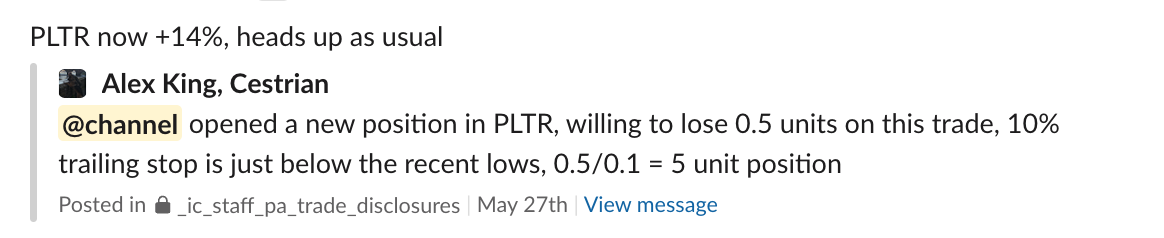
In our Inner Circle service we have a veritable wall of names running up quickly at present, names we were able to buy within their accumulation zones, with tight stops, which are now printing double-digit gains in double-quick time. Here’s $PLTR today.
We also use a simple momentum method for high growth stocks that just love to climb. After the paywall below you can watch the recording of this week’s live webinar where we touch on this and other matters, and you can see all this week’s trades.